Kidney stones and renal colic: symptoms, treatment and prevention
Dr. Abdellatif Mitach · 6 min read · Published on
Sudden back pain, nausea, blood in the urine… How to recognise renal colic, when to go to the emergency department, which treatments exist and how to stop stones coming back.
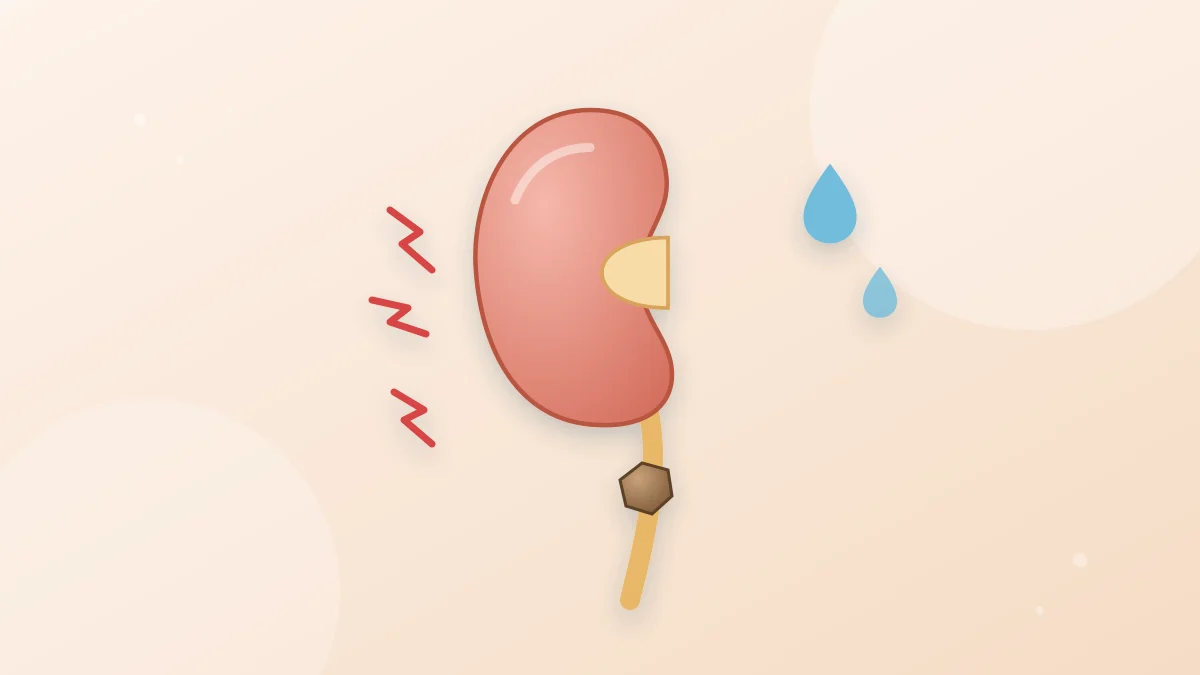
Kidney stones are one of the most common reasons to see a urologist: about one person in ten will have at least one in their lifetime. Their best-known symptom, renal colic, is among the most intense pains a person can experience.
The good news: most stones pass on their own, today's treatments are minimally invasive, and a few simple habits greatly reduce the risk of another stone.
What is a kidney stone?
A stone forms when some substances in the urine (calcium, oxalate, uric acid…) are too concentrated: they crystallise and clump together into a small pebble. It can stay in the kidney without symptoms for years, or move into the ureter, the thin tube that connects the kidney to the bladder.
About three stones in four are made of calcium oxalate. Other types include uric acid, calcium phosphate, infection stones and, more rarely, cystine. Knowing what a stone is made of helps tailor prevention.
What are the symptoms of renal colic?
Renal colic happens when a stone blocks the flow of urine in the ureter. Pressure builds up in the kidney, causing:
- sudden, very intense pain on one side, in the lower back or side;
- pain that spreads to the lower abdomen, groin or genitals;
- restlessness: no position brings relief;
- often nausea or vomiting;
- sometimes frequent urges to urinate, burning or blood in the urine.
A stone sitting in the kidney can also be found by chance on an ultrasound, without any pain.
What should you do during an attack?
See a doctor to confirm the diagnosis and get the right treatment. Anti-inflammatory drugs are often the most effective painkillers for renal colic, but they have contraindications: only take them on medical advice.
How is it diagnosed?
The doctor relies on a clinical examination, a urine test (looking for blood and infection) and a blood test to check kidney function.
Imaging confirms the stone and shows its size and position. A non-contrast CT scan is the reference test. Ultrasound is preferred in pregnant women and children, and is useful for follow-up.
After a recurrence, or with several stones, a metabolic work-up (blood tests and 24-hour urine collection) looks for an underlying cause.
How are kidney stones treated?
The choice depends on the size and position of the stone, the symptoms and whether there is an infection. The table below sums up the most common situations.
| Situation | Treatment usually offered |
|---|---|
| Stone under 5 mm in the ureter | Natural passage, painkillers and monitoring |
| Stone of 5 to 10 mm in the ureter | Medication that helps the stone pass, or ureteroscopy |
| Kidney stone under 2 cm | Shock-wave lithotripsy or flexible laser ureteroscopy |
| Kidney stone over 2 cm | Percutaneous surgery (PCNL) |
| Stone with infection and fever | Emergency drainage of the kidney (JJ stent), then treatment of the stone |
Shock-wave lithotripsy (SWL)
Shock waves sent through the skin break up the stone. The fragments then pass in the urine. No incision is needed.
Ureteroscopy
A very thin scope is passed through the natural urinary passages up to the stone, which is broken up with a laser and removed. A temporary stent (JJ stent) is sometimes left in the ureter for a few days.
Percutaneous surgery (PCNL)
For large kidney stones, the urologist reaches the kidney directly through a small incision in the back and removes the stone.
How can you stop stones coming back?
Without prevention, about half of patients form another stone in the following years. The most effective measures are simple:
| Do | Limit |
|---|---|
| Water: 2 to 2.5 litres a day, spread through the day | Salt and salty foods (processed meat, canned food, crisps) |
| Pale urine at any time of day | Too much red meat and animal protein |
| Normal amounts of dairy products | Fizzy drinks, especially cola |
| Fruit, vegetables and lemon | Oxalate-rich foods if your stones contain oxalate (spinach, chocolate) |
Should you see a urologist after renal colic?
Yes. Even if the pain is gone, you need to check that the stone has passed and the kidney is no longer blocked. The visit is also the chance to analyse the stone and set up the right prevention, especially after several episodes.
To learn which other signs should prompt a visit, read our article When should you see a urologist? 7 signs not to ignore.
Kidney stone care in Agadir
Dr. Abdellatif Mitach, urologist and andrologist, treats urinary stones — from diagnosis to preventing recurrences — at his practice on Avenue Hassan II in Agadir. See the kidney stones page or book an appointment online.
Sources
- French Association of Urology (AFU), patient information: urofrance.org
- European Association of Urology (EAU), Patient Information: patients.uroweb.org
- French National Authority for Health (HAS): has-sante.fr
Need a consultation?
Book online in seconds. Our team will call you to confirm your time slot.
Book an appointmentThe information on this website is for general information only and does not replace a medical consultation.
Read next
 Conseils
Phimosis and circumcision: what you need to know
A foreskin that won't pull back, infections, discomfort during sex… Normal versus pathological phimosis, treatment with cream or surgery, paraphimosis, and circumcision under proper medical conditions.
 Conseils
Blood in the urine (haematuria): causes, emergencies and tests
Red or pink urine, even once: blood in the urine must always be investigated. Possible causes, emergency signs and what the work-up involves (ultrasound, CT urogram, cystoscopy).
 Conseils
Varicocele: symptoms, fertility and treatment
A heavy feeling in the scrotum, swollen veins, an abnormal semen analysis… Varicoceles are common and often harmless. How to recognise one, when it should be treated and which techniques exist.